The Daily Shaarli
March 7, 2024

Jacobin | Finance’s dominance over the economy isn’t a deviant evolution of a “good” industrial capitalism. Finance and industry are interdependent — meaning solving problems like inequality and climate change will require a far-reaching democratization of the economy.

Amidst the genocide against Palestinians and the war in Congo, human beings cling to hope. Saleem, in Rafah, dreams beyond the present, of Red Books Day and a brighter future.

Jacobin | Since Labor PM Paul Keating’s early ’90s privatization spree, Australian governments have been obsessed with public-private partnerships. It’s a model that spends public money to subsidize private profits — often with disastrous outcomes.

Canadian Dimension | Aaron Bushnell’s supreme sacrifice cuts like a knife through the Orwellian doublethink—mass slaughter of innocent civilians is “self-defense,” the IDF is “the most moral army in the world”—that allows us to continue to live with what the highest court in the world has described as a plausible genocide.
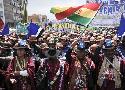
Jacobin | The conflict between Evo Morales and Luis Arce for the Bolivian presidency in 2025 has not only split the ruling MAS party but also the social movements and labor unions that form its base.

Jacobin | The South has long remained a nearly impenetrable citadel for labor. Fresh off of the success of its Big Three strike last year and looking to organize an Alabama Mercedes plant, the United Auto Workers wants to storm the castle.

CADTM | After the Second World War, in a growing number of Third World countries, policies diverged from those of the former colonial powers. This trend encountered firm opposition from the governments of the major industrialised capitalist countries whose influence held sway with the World Bank (WB) and the IMF. WB projects have a strong political content: to curtail the development of movements challenging the domination/rule of major capitalist powers. The prohibition against taking “political” and “non-economic” considerations into account in WB operations, one of the most important provisions of its charter, is systematically circumvented. The political bias of the Bretton Woods institutions is shown by their financial support to dictatorships ruling in Chile, Brazil, Nicaragua, Congo-Kinshasa and Romania.